


The candle on your desk, the lip balm in your pocket, the cardboard box your last online order arrived in — none of them have much in common on the surface. Underneath, they share the same industrial material. Petroleum waxes are embedded in more of daily life than most people realize, and the reason they stay invisible is precisely because they work so well. That invisibility is worth examining.
A Material Category That Operates Below the Radar
There is a class of industrial materials that never gets named on a label but determines whether a product performs, holds its shape, resists moisture, or survives a supply chain. Petroleum waxes sit firmly in that category.
Derived from crude oil refining, these waxes are separated during the processing of lubricating oils and then refined to varying degrees of purity depending on application. The result is a spectrum of materials — from soft, low-melting microcrystalline waxes to harder, higher-melting paraffins — each engineered for specific performance conditions. Petroleum waxes are not a single substance. They are a material family, and that distinction matters when you start mapping where they actually appear.
The reason this topic is relevant now is structural. As manufacturers face pressure to improve barrier performance in sustainable packaging, extend product shelf life without synthetic additives, and meet increasingly specific regulatory requirements in food contact and cosmetics applications, the demand profile for these materials is intensifying across multiple industries simultaneously.
How Petroleum Wax Actually Functions in a Product
Most people’s mental model of wax is a coating. That is accurate but incomplete.
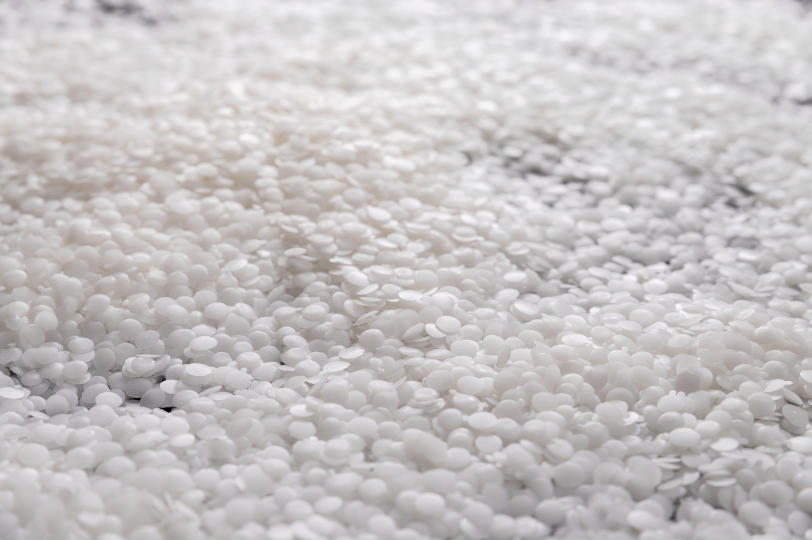
At the molecular level, petroleum waxes function through crystalline structure. Paraffin wax, the most widely recognized type, is composed of straight-chain hydrocarbons that pack tightly into a crystalline lattice as they cool and solidify. That structure is what gives it barrier properties — it resists water vapor transmission, blocks oxygen migration, and creates a surface that most contaminants cannot penetrate without significant energy input.
Microcrystalline wax has a branched molecular structure rather than a straight-chain one, which makes it more flexible, tackier, and better at adhesion. It melts at higher temperatures than paraffin, which makes it preferable in applications where thermal stability matters.
Why Formulation Precision Matters at Industrial Scale
The performance window for these materials is narrow in most applications. A cosmetic formulation that requires a wax with a melting point of 58 to 62 degrees Celsius cannot substitute one that melts at 52. A food-grade barrier coating that must meet FDA 21 CFR requirements cannot use a wax that carries residual oil content above specification. Industrial buyers are not purchasing a commodity. They are purchasing a material that has to perform within a defined parameter set across every batch, at scale, under varying ambient conditions.
This is why specialized suppliers exist in this space. Companies like IGI Wax engineer and supply petroleum-derived waxes at industrial scale, formulating across grades to meet the precise performance and regulatory requirements of customers in food packaging, cosmetics, adhesives, candle manufacturing, and electronics — sectors that look nothing alike on the surface but share the same underlying material dependency.
Where These Materials Actually Show Up
The food packaging industry is one of the largest consumers. Corrugated boxes used in produce transport, paper plates, butcher paper, and fruit coatings all rely on wax barriers to control moisture migration and extend shelf integrity. The wax is rarely visible. It is either absorbed into the substrate or applied in a layer thin enough to be imperceptible.
Cosmetics is another significant application area. Lipsticks, balms, creams, and solid perfumes use wax to control texture, melting behavior, and application feel. The formulation challenge in this category is that the wax must perform consistently across a wide temperature range — stable enough to survive retail display in summer conditions, soft enough to apply cleanly at skin contact.
In electronics, microcrystalline wax appears as a potting and encapsulation material for components that need protection from vibration and moisture without the rigidity of hard resins. In adhesives, wax modifies the tack and thermal resistance of hot melt formulations. In candle manufacturing, the crystalline behavior of paraffin determines burn rate, fragrance throw, and surface finish.
What the Industry Gets Wrong About These Materials
The most persistent misconception is that petroleum-derived means unregulated or interchangeable. Neither is true.
Food-contact waxes are subject to FDA oversight and must meet compositional standards that exclude certain processing aids and limit residual hydrocarbon content. Cosmetic-grade waxes are evaluated under EU Cosmetics Regulation and similar frameworks in other jurisdictions. Using an industrial-grade wax in a food or personal care application is not a cost optimization. It is a compliance failure.
The second misconception is that bio-based alternatives have already displaced petroleum waxes in most applications. The reality is more nuanced. Plant-based waxes — carnauba, candelilla, rice bran — serve specific niches well, particularly in clean-label food and premium cosmetics. But they carry their own performance limitations, supply chain volatility, and cost premiums that make them impractical substitutes at industrial volumes in many categories. The displacement narrative is real but overstated relative to where the market actually sits today.
The Supplier Infrastructure Behind the Material
What makes petroleum waxes a strategically interesting material category is the supplier layer that most end consumers never see. Industrial manufacturers do not buy wax from a general commodity broker and reformulate it themselves. They source from specialists who have already done the refinement, testing, and regulatory documentation work upstream.
That supplier relationship is where product performance is actually determined. A candle manufacturer whose wax supplier shifts processing parameters by a fraction of a percent can see crystallization behavior change in ways that affect surface appearance and burn consistency at retail scale. A packaging converter whose wax barrier performs below spec loses a food safety certification, not just a customer. The material is invisible in the product, but the supplier relationship is load-bearing in the operation.
Where the Material Category Is Heading
Sustainability pressure is reshaping the demand side without eliminating it. Manufacturers are not abandoning petroleum waxes. They are asking for more precise grades, better documentation of sourcing and processing, and in some cases, blended formulations that incorporate bio-based components while maintaining the performance profile of a fully petroleum-derived material.
The regulatory environment is also tightening around food contact materials specifically, with the EU Food Contact Materials regulation revision and equivalent activity in the US creating new documentation requirements that favor established, specialized suppliers over commodity channels.
The products that rely on petroleum waxes are not going away. The applications are too embedded, the performance requirements too specific, and the alternatives too limited at scale to enable a rapid transition. What is changing is the sophistication required to supply these materials — tighter specs, more traceability, and a buyer base that is better informed than it was a decade ago. The material stays invisible. The infrastructure behind it is becoming more visible by necessity.
